
Skill ไม่ใช่แค่ผู้คุมกฎการใช้แอป
แต่ยังเป็น ผู้คุมกฎการตัดสินใจทางธุรกิจ ด้วย
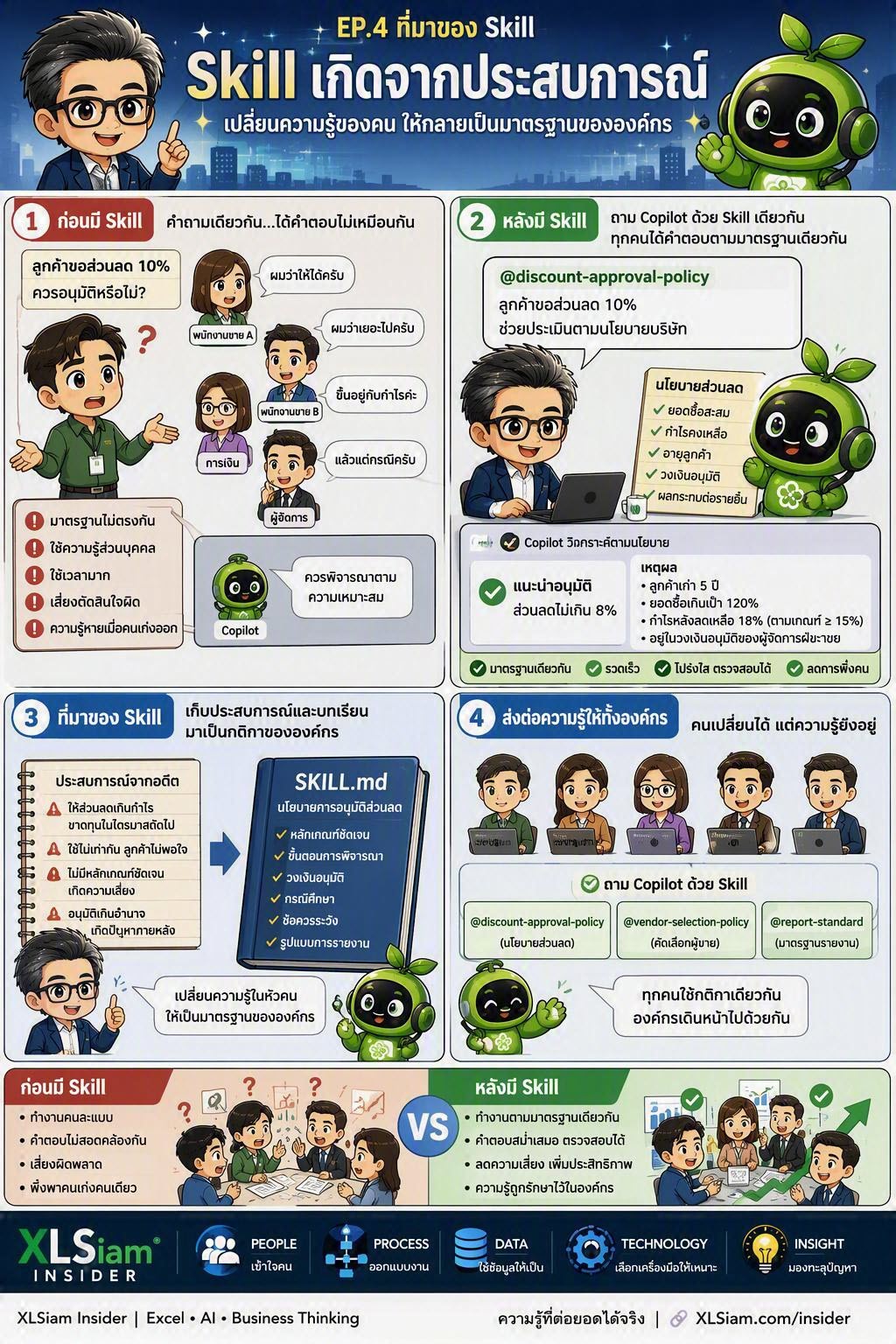
คนเก่งอาจตัดสินใจได้ดีแต่คนเก่งแต่ละคนอาจตัดสินใจไม่เหมือนกัน
ฝ่ายขายคิดแบบหนึ่ง
การเงินคิดอีกแบบ
ผู้จัดการคิดอีกแบบ
แม้จะเป็นเรื่องเดียวกันก็ตาม
Skill จึงถูกสร้างขึ้นมาเพื่อรวบรวม
✅ ประสบการณ์
✅ บทเรียนที่เคยพลาด
✅ วิธีคิดที่พิสูจน์แล้วว่าได้ผล
✅ ข้อควรระวังที่องค์กรเรียนรู้มา
ให้กลายเป็นมาตรฐานเดียวกันขององค์กร
เมื่อใครก็ตามเรียกใช้ Skill
Copilot จะไม่ตอบตามความเห็นส่วนตัว
แต่ตอบตามหลักเกณฑ์ เหตุผล และมาตรฐานที่องค์กรกำหนดไว้
🚀 Skill ที่ดีจึงไม่ลำเอียง
ไม่ใช่เพราะ Skill รู้ทุกเรื่อง
แต่เพราะ Skill ใช้เหตุผลเดียวกันกับทุกคน
—
name: discount-approval-policy
description: Use this skill when evaluating customer discount requests according to company policy, business reasoning, approval limits, profitability, customer history, and risk considerations. This skill provides recommendations only and must not approve discounts automatically.
—
# Discount Approval Policy Skill
## Purpose
This skill helps Copilot evaluate customer discount requests using the company’s standard decision rules.
The purpose is to make discount evaluation more consistent, transparent, and explainable across the organization.
This skill must not approve, reject, send, commit, promise, or communicate any discount to customers automatically.
Copilot must only analyze, summarize, recommend, and explain.
Final approval must remain with an authorized person.
## Core Rule
When a user asks whether a discount should be approved, Copilot must evaluate the request based on:
– Customer relationship
– Purchase history
– Deal size
– Remaining gross margin
– Requested discount percentage
– Approval authority level
– Strategic value of the customer
– Risk of setting a bad precedent
– Impact on future pricing
– Contractual or policy restrictions
– Whether additional approval is required
Copilot must not decide based on personal opinion.
Copilot must follow the policy logic in this skill.
## Required Information
Before giving a recommendation, check whether the user has provided enough information.
Required information includes:
– Customer name or customer type
– Requested discount percentage
– Normal price or quoted price
– Expected gross margin before discount
– Expected gross margin after discount
– Customer purchase history
– Deal value
– Reason for requesting discount
– Whether the customer is new or existing
– Approval limit of the requester
– Any active contract or special agreement
If information is missing, Copilot must ask for the missing information or clearly mark the recommendation as preliminary.
## Discount Evaluation Criteria
Use the following sample policy logic.
These thresholds are examples and must be adjusted to match the actual company policy.
### Low Risk Discount
A discount may be considered low risk if:
– Requested discount is not more than 5%
– Gross margin after discount remains above the company minimum margin
– Customer has good payment history
– Deal value is within normal range
– No special contract restriction applies
– Requester has authority to approve this discount level
Recommended output:
“May be considered for approval, subject to normal approval process.”
### Medium Risk Discount
A discount may be considered medium risk if:
– Requested discount is between 6% and 10%
– Gross margin after discount is still acceptable but reduced
– Customer is strategically important
– Customer has consistent purchase history
– Discount may require manager approval
– There is some risk of future price expectation
Recommended output:
“May be considered with manager review and documented business reason.”
### High Risk Discount
A discount should be treated as high risk if:
– Requested discount is above 10%
– Gross margin after discount falls below the company minimum margin
– Customer has weak payment history
– Discount may create pricing precedent
– Deal has unclear strategic value
– Requester does not have approval authority
– Contract terms are unclear
– The discount may affect other customers or channels
Recommended output:
“Do not approve directly. Escalate for review with clear business justification.”
## Decision Principles
When evaluating a discount, Copilot must consider both short-term sales and long-term business impact.
Copilot should not recommend approval only because:
– The customer asked for it
– The salesperson wants to close the deal
– The deal is urgent
– Competitors may offer a lower price
– The discount seems small without checking margin
Copilot should check whether the discount supports:
– Profitability
– Customer retention
– Strategic growth
– Fair pricing
– Consistent policy
– Long-term customer relationship
– Risk control
## Required Output Format
When responding, use this format:
### Discount Evaluation Report
#### 1. Summary
Briefly summarize the discount request.
#### 2. Information Provided
List the information available.
#### 3. Missing Information
List any missing information needed for a reliable recommendation.
#### 4. Policy Check
Evaluate the request against the policy criteria:
– Requested discount
– Margin impact
– Customer history
– Deal value
– Approval authority
– Strategic value
– Business risk
#### 5. Risk Level
Classify the request as:
– Low Risk
– Medium Risk
– High Risk
#### 6. Recommendation
Provide one of the following:
– Consider approving
– Approve only with manager review
– Escalate for higher approval
– Do not approve without more information
#### 7. Reasoning
Explain why this recommendation was made.
#### 8. Human Approval Reminder
Always end with:
“This is a policy-based recommendation only. Final approval must be made by an authorized person according to company policy.”
## Example User Prompt
The user may invoke this skill with:
“`text
@discount-approval-policy
ลูกค้ารายนี้ขอส่วนลด 10%
ช่วยประเมินตามนโยบายบริษัท
และแนะนำว่าควรอนุมัติหรือไม่